Neighbors in Shadow: Understanding the India-Pakistan Rivalry and the Path to Lasting Peace
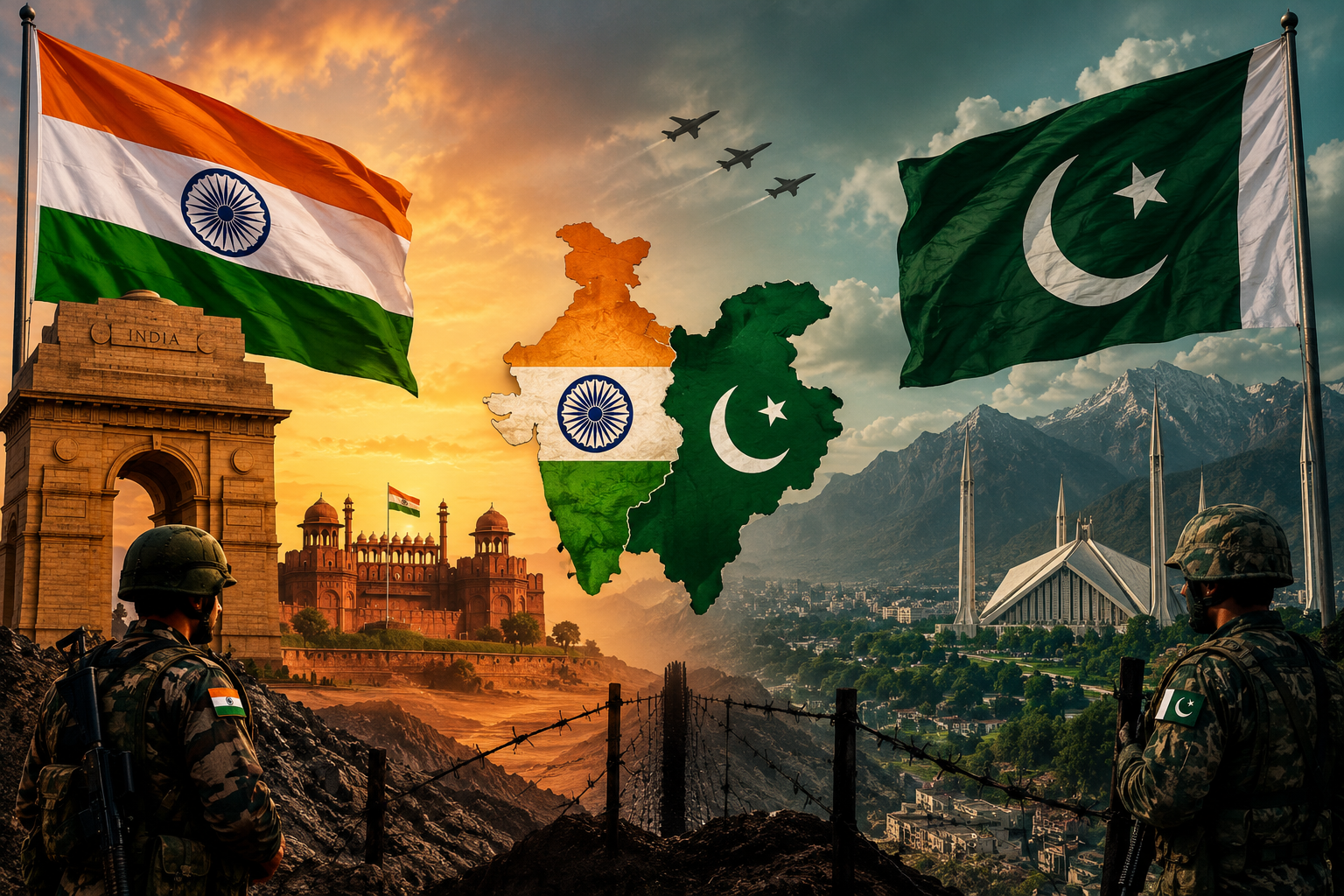
Despite their shared history, cultural traditions, languages, and social connections, India and Pakistan have remained involved in one of the longest-running geopolitical rivalries in the world. Since the partition of British India in August 1947, the two neighboring countries have experienced several wars, repeated border clashes, and long periods of diplomatic tension. Understanding this rivalry requires examining its historical origins, competing national identities, security concerns, and the possibilities for peaceful cooperation.
1. The Root Causes of the Conflict
The tensions between India and Pakistan cannot be explained by a single dispute. Instead, they are the result of several interconnected historical, political, and security-related factors.
The Legacy of Partition (1947)
The partition of British India in 1947 resulted in the creation of two independent states: India and Pakistan. Pakistan was established as a homeland for the Muslims of the subcontinent, while India adopted a secular constitutional framework. Partition was accompanied by widespread communal violence, mass migration, and the displacement of millions of people. The human suffering and trauma of that period left a lasting impact on the societies and national identities of both countries.
The Kashmir Dispute
The dispute over Jammu and Kashmir became a major source of conflict soon after independence. Both India and Pakistan claim the territory, while different parts of the region remain under their respective administrations, separated largely by the Line of Control (LoC). Kashmir has been at the center of several major military conflicts and continues to be one of the most sensitive issues in bilateral relations.
Security Concerns and Nuclearization
Decades of mutual distrust encouraged both countries to develop large military capabilities. Their nuclear tests in May 1998 formally established both India and Pakistan as nuclear-armed states. Nuclear deterrence has created a powerful constraint on large-scale war, but it has also increased international concern because even a limited military crisis could potentially escalate into a much more dangerous confrontation.
Cross-Border Security and Mutual Mistrust
Relations have repeatedly deteriorated because of accusations involving cross-border terrorism, militant activity, intelligence operations, and interference in domestic affairs. India has consistently emphasized terrorism and security as major obstacles to meaningful dialogue, while Pakistan has highlighted the Kashmir dispute, human rights concerns, and allegations of Indian involvement in its internal affairs. These competing narratives have made it extremely difficult to establish lasting trust.
2. Why the Rivalry Persists
The continuation of the India-Pakistan rivalry is influenced not only by territorial disputes but also by political, economic, and social factors.
Domestic Politics and Nationalism
Political leaders and sections of the media in both countries have, at different times, used nationalist rhetoric and negative portrayals of the neighboring country to strengthen domestic political support. Such narratives can make compromise politically difficult and reinforce public mistrust.
Limited Economic Interaction
Despite their geographic proximity and shared economic history, formal trade between India and Pakistan remains far below its potential. Trade restrictions, political tensions, limited transportation links, and strict visa policies have prevented the two economies from developing stronger interdependence. Greater economic interaction could create incentives for stability and cooperation.
Changing Geopolitical Relationships
The broader international environment has also influenced the rivalry. India and Pakistan have developed different strategic partnerships with major global powers, including the United States, China, Russia, and others. These relationships have sometimes affected regional security calculations and contributed to the strategic competition between the two countries.
3. How Can the Conflict Be Reduced?
A lasting settlement between India and Pakistan would require patience, sustained diplomacy, and a willingness to address security concerns while recognizing areas of mutual interest. Peace would not depend on resolving every disagreement immediately; it could begin with practical steps that reduce tensions and gradually rebuild trust.
Regular communication is essential for preventing misunderstandings and managing crises. India and Pakistan could pursue structured negotiations covering issues such as terrorism, Kashmir, border security, military confidence-building measures, and economic relations. Quiet diplomatic channels could also allow sensitive matters to be discussed without the immediate pressure of public political debate.
Expanding Trade and Economic Cooperation
Increasing legitimate trade and economic interaction could provide practical benefits to both countries. Simplifying trade procedures, improving transportation links, reducing unnecessary barriers, and strengthening regional economic cooperation could encourage businesses and communities to support greater stability.
Promoting People-to-People Contacts
Greater opportunities for students, academics, artists, athletes, journalists, and divided families to interact could help reduce stereotypes and build mutual understanding. Cultural exchanges and sporting events, particularly cricket, have demonstrated the potential of ordinary human connections to create goodwill even during periods of political tension.
Strengthening Confidence-Building Measures
Military confidence-building measures can help reduce the risk of accidental escalation. Existing communication mechanisms, including military hotlines, can be strengthened, while commitments concerning ceasefires and border management can be maintained. Cooperation in areas such as water management, environmental protection, disaster response, and climate change could provide additional opportunities for practical collaboration.
Conclusion
The India-Pakistan rivalry is deeply rooted in history, territorial disputes, national identities, and decades of mistrust, but conflict between the two countries is not inevitable. Sustainable peace would require political courage, consistent diplomacy, effective security mechanisms, and gradual confidence-building.
The two countries also face many common challenges, including poverty, water stress, environmental degradation, economic development, public health, and the effects of climate change. Cooperation in these areas does not require both sides to abandon their existing positions on difficult political questions.
A more stable relationship could therefore be built step by step: through dialogue, economic cooperation, people-to-people connections, and mechanisms designed to prevent crises from escalating. Moving from confrontation toward peaceful coexistence would not erase the history that separates the two countries, but it could create a future in which their shared geography and heritage become reasons for cooperation rather than continued conflict.

0 comments